400 Americans Confessed the Elaborate Lies They Tell on Dates and Honestly, We're All Auditioning for Something
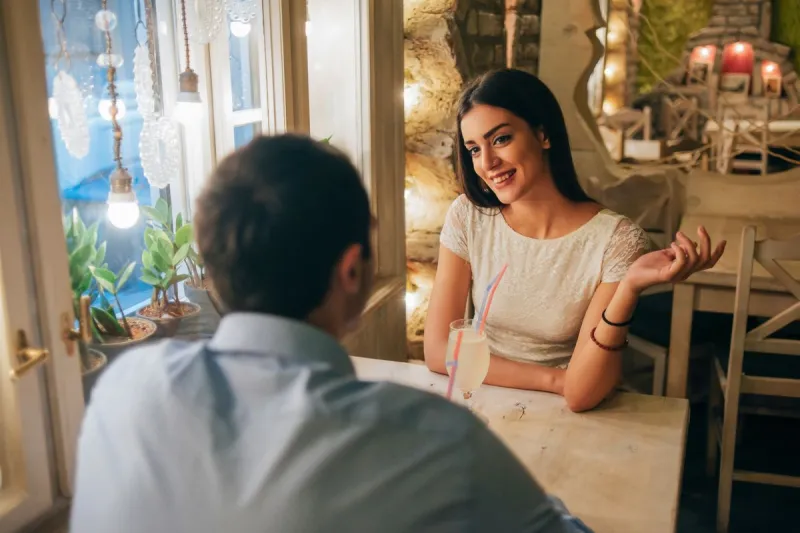
Photo: couple on awkward first date at restaurant smiling nervously, via i2-prod.mirror.co.uk
Somewhere between the first drink order and the third "wow, that's so interesting," a switch flips. You stop being yourself and start being the slightly better, more patient, mysteriously adventurous version of yourself that you'd like a stranger to fall for. It's not lying, exactly. It's performing. And according to 400 Americans who were brave enough to confess their dating theatrics to us, pretty much everyone is doing it.
We asked people to come clean about the things they fake, force, or flat-out invent during dates. The results were a masterclass in human desperation, optimism, and the universal desire to seem like someone who has it together.
The Laugh That Could Win an Emmy
The single most common confession — and by a landslide — was fake laughing at jokes that simply did not land. Sixty-three percent of respondents admitted to performing a laugh on a date that they absolutely did not feel in their body.
Not a polite chuckle. A laugh. Full eye crinkle. Maybe a hand on the arm. A "oh my god, stop" delivered to someone whose joke was, objectively, a war crime against comedy.
"He did this bit about airline food," one 28-year-old from Ohio wrote. "It was 2023. I laughed for forty-five seconds."
The reasons people gave were surprisingly self-aware: they didn't want to embarrass their date, they figured the person was nervous, or — most honestly — they just really wanted things to go well and laughter felt like social glue. Which, fair. But also, we've created a world where people are performing stand-up sets to audiences of one, receiving standing ovations they did not earn, and then going home confused about why the relationship eventually felt hollow.
The Hobby Hostage Situation
Coming in at a close second: pretending to be interested in someone's niche hobby or passion project. Forty-eight percent of respondents said they have sat through a detailed explanation of something they found genuinely boring — and responded with enthusiasm they absolutely did not feel.
The hobbies in question ranged from mildly tedious to absolutely unhinged:
- Fantasy football leagues (with full standings breakdowns)
- Artisanal hot sauce fermentation
- A guy's podcast "that's really about to take off"
- CrossFit. Just... CrossFit. Multiple times.
- A 20-minute explanation of why one specific brand of mechanical keyboard is superior to all others
- Someone's "investment strategy" that was clearly just vibes
"He explained the entire lore of a video game franchise for an hour," one 31-year-old from Texas reported. "I nodded. I asked follow-up questions. I have never felt more like a hostage."
And yet — she went on a second date. Because dating is a strange and powerful drug.
The Origin Story Nobody Asked For
Thirty-nine percent of respondents admitted to pretending to be engaged while someone told them their life story in excruciating detail during a first date. Not a highlight reel. The full story. Childhood, the complicated relationship with a parent, the "dark period" in college, the spiritual awakening via a solo road trip to Sedona.
On paper, vulnerability is beautiful. In practice, when you're 22 minutes into a first date and still in someone's middle school years, there is a very specific kind of polite suffering happening behind your eyes.
"I know more about his estranged relationship with his father than I know about my own family," wrote a 34-year-old from California. "We went on two dates. I was basically his therapist."
People weren't cruel about it — most said they genuinely tried to be present and empathetic. But there's a difference between being a good listener and being a human emotional dumpster that someone mistakes for romantic chemistry.
The Food Diplomacy Act
Twenty-seven percent of people admitted to pretending to like food they either didn't enjoy or actively hated — because their date picked the restaurant and they didn't want to seem difficult.
This one stings a little, because food is so personal. People are out here eating things that offend them on a molecular level, smiling through it, saying "this is amazing" about a dish they would not feed to an enemy.
"He took me to this hyper-authentic Peruvian place and ordered for both of us without asking," one 29-year-old from New York wrote. "I ate something I genuinely could not identify. I said it was delicious. I googled what it was in the Uber home and screamed."
Others admitted to claiming they "weren't that hungry" to avoid eating something weird, or suddenly discovering a "small allergy" that conveniently covered the item they feared most.
Romance is a public health hazard, apparently.
The Opinions We Don't Actually Have
Perhaps the most philosophically interesting confession: twenty-two percent of people said they've adopted opinions during a date — about movies, music, politics, or culture — based entirely on what they sensed their date wanted to hear.
This isn't agreeing to be polite. This is actively constructing a personality in real time based on audience feedback. Someone mentions they love jazz, and suddenly you love jazz. Someone makes a comment about a TV show, and you recalibrate your entire stated viewing history.
"I told him I was really into hiking," one 26-year-old from Seattle wrote. "I have never voluntarily hiked. I then had to hike. Twice. I am still recovering."
The irony, of course, is that both people at the table might be doing this simultaneously — two humans carefully constructing mirror images of each other, falling for reflections, and then being baffled when the real person eventually shows up six weeks later eating cereal for dinner and refusing to hike.
Why We Do This (We Know Why We Do This)
Here's the thing: none of this is surprising, and most of it is kind of sweet in a chaotic, self-defeating way. Dating is inherently high-stakes. You're asking a stranger to like you before they actually know you, which means you're selling a version of yourself that's slightly aspirational — a little more patient, a little more open-minded, a little more willing to learn about mechanical keyboards than you would be under normal circumstances.
The performances aren't malicious. They're hopeful. They're the human equivalent of putting on a good outfit and hoping someone sees past it to the person underneath, who is mostly fine but also tired and has strong opinions about snacks.
The real question isn't why we fake it on dates. It's when — and whether — we feel safe enough to stop.
Until then: keep laughing at the jokes. Keep nodding through the podcast pitches. Keep pretending you know what umami means.
We're all just doing our best out here, one performance at a time.